Welcome to the official website of Jiangsu Mengfan Machinery Co., Ltd. We specialize in steel structure production, 3D flexible welding platforms, and sand blasting and painting. Our factory has advanced equipment, strong technical strength, and complete supporting casting and mechanical processing equipment. The products are complete, the design is reasonable, the structure is stable, the precision is high, the wear resistance is high, and the service life is long.


Three-dimensional flexible fixture series
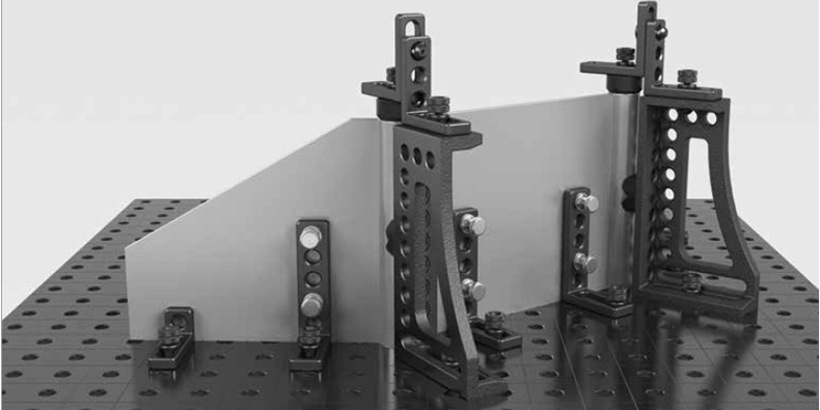
A three-dimensional flexible fixture is a fixture system used to support, position and fix workpieces. Compared with traditional rigid fixtures, three-dimensional flexible fixtures are deformable and adjustable, and can adapt to workpieces of different shapes and sizes.
The following are some characteristics and advantages of three-dimensional flexible fixtures:
Deformability: Three-dimensional flexible fixtures use flexible materials or adjustable mechanisms, which can be deformed and adjusted according to the shape and size of the workpiece. This deformability enables the fixture to adapt to workpieces of various complex shapes and improve the accuracy and stability of clamping.
Adaptability: Three-dimensional flexible fixtures can adaptively adjust the clamping force according to the surface shape and characteristics of the workpiece. Through sensors and control systems, the fixture can monitor the deformation and position of the workpiece in real time, and adjust the clamping force to ensure the stability and safety of the clamping.
Versatility: Three-dimensional flexible fixtures can achieve multiple functions, such as positioning, support, fixation and processing guidance. Through flexible design and structure, the fixture can meet different process and work requirements and improve production efficiency and quality.
High precision and repeatability: 3D flexible fixtures can provide high-precision clamping and positioning, ensuring the accuracy and repeatability of workpiece processing. The adjustability and adaptability of the fixture can reduce processing errors and deformations, and improve the processing quality of the workpiece.
Cost savings and flexibility: Compared with traditional rigid fixtures, 3D flexible fixtures have lower design and manufacturing costs and can adapt to a variety of workpieces. The adjustability and reusability of the fixture can reduce the manufacturing and adjustment time of the fixture and improve production efficiency.
3D flexible fixtures are widely used in the fields of automobiles, aerospace, shipbuilding, machinery manufacturing, etc. They can meet the requirements of complex workpiece processing and assembly, improve production efficiency, reduce costs, and provide more flexible and reliable clamping solutions.

Mobile:+86 138-6166-4235
Address:No. 18, Xitong Avenue, Nantong City, Jiangsu Province
Telephone:+86 138-6166-4235

Scan the QR code
Copyright © 2024 Jiangsu Mengfan Machinery Co., Ltd. all rights reserved